Baptism by Fire: Lessons from Emergency Remote Learning
14 min read
In March 2020, educators around the world experienced what can only be described as an educational baptism by fire. Without warning, without preparation, and without the luxury of a gradual transition, millions of instructors dove headfirst into the previously uncharted waters of emergency remote learning. For institutions built on the foundation of face-to-face connection, where teaching had always been an act of personal relationship, the sudden shift to screens and distance felt like a betrayal of everything we knew about effective education.
The research that emerged from this crisis tells a profound story, one that validates what many of us sensed instinctively: when we stripped away the physical presence of our classrooms, something essential went missing. That something has a name: social presence. And understanding what happened to social presence during emergency remote learning offers us critical lessons for the future of education, whether that future unfolds online, in person, or in some hybrid space between.
What Happened When the World Went Remote
A landmark study by Ensmann, Whiteside, Gomez-Vasquez, and Sturgill (2021), published in the Online Learning Journal, captured the student experience during the March 2020 lockdown transition at a medium-sized private university. The findings reveal the depth of what students lost and what they desperately needed.
The researchers employed the Social Presence Model (SPM), developed by Whiteside (2007, 2011, 2015), as their guiding framework. This model views social presence as the culmination of five interconnected elements: Affective Association (emotional connection), Community Cohesion (interconnectedness), Instructor Involvement (instructor actions and student reactions), Interaction Intensity (level of engagement), and Knowledge and Experience (what students bring and share).
What emerged from 507 student responses was a picture of profound disconnection. Students reported feelings of "loneliness, lack of motivation and a lot of mixed emotions" (Ensmann et al., 2021, p. 47). One student captured the shock: "The whole thing was a shock that I couldn't have prepared myself for. I went home for spring break thinking I'd be here for a week and learned I'd be home for 6 months" (p. 47).
The Data Tells the Story
Perhaps the most striking finding from the Ensmann et al. (2021) study was the statistical association between student classification and remote-learning success. First-year college students struggled most significantly, averaging closer to two stars (out of five) when rating whether remote learning worked well for them, while graduate students averaged over three stars. This steady incline in satisfaction as education classification increased reveals something crucial: experience with navigating educational systems matters.
Even more telling was the relationship between prior online learning experience and remote learning success. Students with less than one year of online or hybrid experience rated remote learning significantly lower than those with one to three years of experience. At this particular institution, 83% of students had less than one year of prior online experience, reflecting an institutional culture built on face-to-face connection (Ensmann et al., 2021).
These findings align with broader research showing that online learning readiness is not automatic. As Martin, Stamper, and Flowers (2020) noted, students need preparation in multiple dimensions: their attributes as online learners, time management, communication, and technical skills. When students lack this preparation and suddenly find themselves in crisis-mode remote learning, the results can be devastating.
Understanding Social Presence: The Five Elements
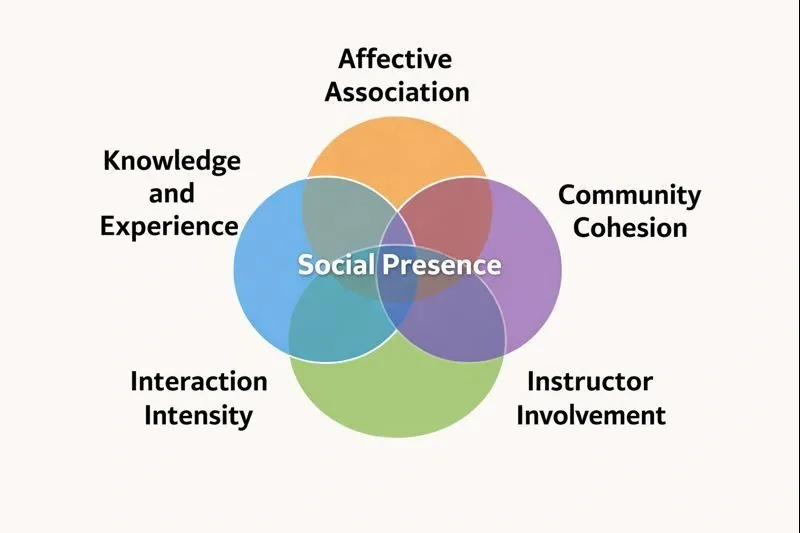
The Social Presence Model provides a powerful lens for understanding why emergency remote learning felt so different from intentionally designed online education. Each of the five elements revealed specific breakdowns during the transition.
Affective Association
This element addresses emotional connection, including instances of emotion such as sadness, anger, frustration, and joy. The coding revealed three main themes: loneliness and isolation, anxiety and depression, and stress. One student expressed the overwhelming nature of the experience: "Adapting to a completely new system of learning, coping with professors' confusion, stress from being socially isolated, stress from an international pandemic occurring that is killing thousands EVERY DAY" (Ensmann et al., 2021, p. 47).
Recent research by Kreijns, Yau, Weidlich, and Weinberger (2024) confirms that social presence reduces feelings of social isolation and loneliness, which the pandemic heightened dramatically. Their comprehensive framework emphasizes that social presence renders concrete benefits for learning, including comparing notes, correcting misunderstandings, building trust, and forming communities of learners.
Community Cohesion
The Community Cohesion element relates to the interconnectedness of the course community. Students' responses fell into three themes: inauthenticity and awkwardness of remote classes, missing peers, and feeling disconnected. One student captured this sentiment: "Not seeing people face-to-face and the awkwardness of online conversation" made learning feel forced and unnatural (Ensmann et al., 2021, p. 48).
This finding resonates with what Wenger (2000) described as learning being a "social becoming" (p. 227). When the social fabric of the classroom was suddenly stripped away, students lost the informal negotiations of meaning that make learning stick. As Zhao and Kuh (2004) noted, learning communities involve social construction of information, making learning "deeper, more personally relevant, and becomes a part of who the student is" (p. 117).
Instructor Involvement
The most heavily coded element in the Ensmann et al. (2021) study was Instructor Involvement, with 87 codes separated into three areas: empathy, planning, and flexibility. Students equated caring professors with those who showed accommodation, held office hours, and tried to create a new "normal." One student noted: "Teachers were accommodating, despite a dreadful situation" (p. 49).
However, Rutherford et al. (2021) observed a troubling pattern: many faculty members became considerably less socially present during the pandemic. Instructors tended to shift from "highly-supportive F2F profiles to less supportive profiles" (p. 107). This decrease in support came precisely when students needed more presence, not less.
Interaction Intensity
The Interaction Intensity code emerged 69 times in the study, primarily as a lack of interaction or a severe need for it. Students commented repeatedly on "being alone with little human interaction" and the resulting impact on learning: "not learning anything, little real interaction, hard to retain any information when online" (Ensmann et al., 2021, p. 49).
Research published in 2024 in Behavioral Sciences confirms the critical mediating role of social presence between interaction and learning efficiency. Social interaction predicts learning efficiency through the sequential mediating roles of social presence and learning engagement (Behavioral Sciences, 2024). Without meaningful interaction, the chain breaks down.
Knowledge and Experience
This element appeared least frequently in the coding, with 35 instances. Two themes emerged: lack of support and an unmotivating experience. Students noted "basically having to teach myself everything" and feeling that professors who did not use synchronous technology were not supporting them (Ensmann et al., 2021, p. 50).
One marine biology major captured the challenge of remote learning in hands-on disciplines: "I didn't want to go to class or study. I was very unmotivated. It's hard to learn as a marine bio major online. I'm not getting the hands-on experience" (Ensmann et al., 2021, p. 50).
What Current Research Tells Us
The research published since the pandemic reinforces and extends these findings. A 2024 study implementing a social presence-based teaching strategy found that the intervention enhanced students' social presence in online learning and that students achieved better academic performance when instructors intentionally designed activities to improve social presence (PMC, 2024). A significant correlation was found between academic performance and social presence.
Research on the evolution of social presence using social network analysis found that social presence positively impacts online students' participation, motivation, satisfaction, perceived learning, learning outcomes, and retention (Castellanos-Reyes, Richardson, & Maeda, 2024). The researchers also found that students' social presence evolves through peer interactions over time, suggesting that social presence is not static but develops through intentional community building.
A comprehensive study examining whether pandemic-induced changes persisted found that online learning activities, authentic assessments, and scaffolded assessments all increased post-pandemic (International Journal of Educational Technology in Higher Education, 2023). The crisis forced experimentation, and some of those experiments proved valuable enough to keep.
Connecting Social Presence to the CORE Framework
The Social Presence Model aligns remarkably well with the CORE Framework principles of Concise, Organized, Relevant, and Engaging instruction. Both frameworks recognize that effective education requires intentional design that respects learners and creates meaningful connections.
Concise instruction supports social presence by reducing cognitive overload and creating space for connection. When content is streamlined to essentials, students have cognitive bandwidth for the relational work of learning. As the CORE Framework emphasizes, students' time is currency, and when we waste that currency on unnecessary content, we leave nothing for the social dimensions of learning.
Organized instruction provides the scaffolding that allows social presence to flourish. The Ensmann et al. (2021) study found that students equated instructor planning with caring. When instructors laid out clear strategies for the semester, students felt supported. Organization is not just about content structure; it is about creating predictability that reduces anxiety and allows students to focus on learning and connection.
Relevant instruction connects directly to the Knowledge and Experience element of social presence. When students understand why content matters for their future selves and the people they will serve, motivation becomes self-sustaining. The CORE Framework's emphasis on transparency speeches, explaining the "Value with a capital V" of learning activities, directly addresses the lack of motivation that students reported during emergency remote learning.
Engaging instruction creates the conditions for interaction intensity to thrive. Csikszentmihalyi's (1990) concept of flow, central to the CORE Framework's Engaging pillar, requires the kind of challenge-skill balance that keeps students invested. When engagement drops, interaction withers, and social presence collapses.
Best Practices for Online Education Based on the Social Presence Model
Drawing from the research and the lessons of emergency remote learning, the following best practices emerge for cultivating social presence in online education:
1. Humanize the Learning Experience
Pacansky-Brock, Smedshammer, and Vincent-Layton (2020) developed a framework for humanizing online teaching that emphasizes three principles: presence, empathy, and awareness. Practical strategies include creating welcome videos, using a conversational tone in the syllabus, sharing appropriate personal information, and demonstrating that you are a real person behind the screen. As Cornell University's Center for Teaching Innovation notes, Cornelius-White (2007) found a strong link between instructor warmth and empathy and student success.
2. Design for Connection, Not Just Content Delivery
Conrad and Donaldson (2012) suggest that relationship building is the first phase of engaging the online learner, and it is not to be skipped. Before diving into academic content, invest in icebreakers, social interaction, and establishing community norms. The research consistently shows that students who feel connected to their instructor and peers are more likely to persist, participate, and learn.
3. Leverage Video Strategically
Conklin and Garrett Dikkers (2021) found that students felt more connected when instructors leveraged video, used a conversational tone, incorporated empathy into messaging, and provided timely feedback. In the Ensmann et al. (2021) study, younger students equated synchronous learning with caring about their well-being. Video creates a sense of presence that text alone cannot achieve. Consider instructor-created videos to explain content, video feedback on assignments, and opportunities for synchronous video interaction.
4. Respond Promptly and with Compassion
The Ensmann et al. (2021) study found that over 50% of students valued timely responses (within 12 hours) to inquiries. Research from Ohio State University notes that high-quality feedback is frequent, immediate, specific, discriminating (distinguishing what works from what does not), and lovingly delivered. In online environments, response time becomes a proxy for caring.
5. Build in Multiple Forms of Interaction
Social presence requires interaction, and different students thrive with different interaction modalities. Build in opportunities for student-to-instructor, student-to-student, and student-to-content interaction. Use discussion boards, collaborative projects, peer feedback, synchronous sessions, and asynchronous video tools. The goal is to create multiple pathways for connection.
6. Demonstrate Flexibility Without Abandoning Standards
Students in the Ensmann et al. (2021) study valued instructors who showed "extra flexibility" because "technology doesn't always work well" (p. 49). This aligns with the mentor mindset approach described by Yeager et al. (2014): combining high expectations with high support. Flexibility is not about lowering standards; it is about recognizing that students' lives are complex and that rigid policies can undermine learning.
7. Prepare Students for Online Learning
One of the clearest findings from the pandemic research is that online learning readiness matters. Abdous (2019) found that preparedness improves student satisfaction and reduces anxiety. Consider providing online learning orientations, teaching students time management and self-regulation strategies, and explicitly discussing the skills needed for success in online environments.
8. Support Mental Health and Well-being
The Ensmann et al. (2021) study revealed the depth of anxiety felt by students during emergency remote learning. Mental health support cannot be an afterthought. Build in check-ins, normalize struggles, provide resources, and remember that Maslow comes before Bloom. Students cannot focus on higher-order learning when their basic needs for safety and belonging are unmet.
9. Use Learning Management Systems Thoughtfully
As Schroeder (2020) noted, learning management systems can help instructors build a strong presence by creating a "delicate combination of empathy and simplicity." The key is using LMS features to create consistency, easy navigation, and opportunities for connection rather than simply dumping content into a digital container.
10. Invest in Faculty Development
The Ensmann et al. (2021) study concluded that universities need to provide training and professional development opportunities that consider SPM elements. Cutri, Mena, and Whiting (2020) found that faculty readiness, or lack thereof, had a domino effect on students. Institutions must support instructors in developing the skills to create socially present online learning environments.
The Lasting Lessons of Emergency Remote Learning
The baptism by fire of March 2020 taught us lessons we should never forget. First, social presence is not optional. It is, as Whiteside (2017) argues, a literacy for learning. When we stripped away the physical proximity of our classrooms, we exposed just how much of education's power comes from human connection.
Second, emergency remote teaching is not the same as intentionally designed online education. Hodges et al. (2020) made this distinction clear: emergency remote teaching is "a temporary shift of instructional delivery to an alternate delivery mode due to crisis circumstances." When we evaluate what happened in March 2020, we must remember that faculty had no choice but to teach online even if they did not feel properly prepared to do so or had little prior interest in online teaching.
Third, preparation matters. The students who fared best during emergency remote learning were those with prior online experience and more advanced education. This suggests that building online learning skills should begin early and continue throughout students' educational journeys.
Fourth, the human elements of teaching cannot be replicated by technology alone. Empathy, flexibility, responsiveness, and genuine caring are what students need most, and these come from instructors, not platforms. Technology can facilitate connection, but it cannot replace the instructor who chooses to be present for their students.
Conclusion: Connections Before Curriculum
The title of the Ensmann et al. (2021) study says it all: "Connections Before Curriculum." In times of crisis, students need empathy before content, belonging before assessment, and presence before pedagogy. This is not to say that curriculum does not matter. It is to say that without the foundation of connection, the curriculum cannot do its work.
As we continue to navigate a world where online, hybrid, and in-person learning coexist, the Social Presence Model offers us a compass. It reminds us that social presence involves "participants' motivation to take an active role in their own and their peers' meaning-making processes" (Whiteside, 2007, 2011, 2015, 2017). This motivation does not emerge automatically. It must be cultivated through intentional design that honors all five elements: Affective Association, Community Cohesion, Instructor Involvement, Interaction Intensity, and Knowledge and Experience.
The CORE Framework aligns with these insights. When we design instruction that is Concise, Organized, Relevant, and Engaging, we create the conditions for social presence to flourish. When we recognize that students' time is currency and that education should prepare people to contribute meaningfully to their communities, we honor the human dimension of learning that emergency remote teaching so painfully revealed.
The baptism by fire of 2020 was painful. But from that fire emerged clarity about what matters most in education. The research is unequivocal: social presence is essential. The question now is whether we will carry that lesson forward, building educational experiences that honor connection, cultivate community, and prepare students not just to know things but to become the people their future patients, clients, students, and communities need them to be.
References
Abdous, M. H. (2019). Influence of satisfaction and preparedness on online students' feelings of anxiety. The Internet and Higher Education, 41, 34-44. https://doi.org/10.1016/j.iheduc.2019.01.001 (opens in a new tab)
Castellanos-Reyes, D., Richardson, J. C., & Maeda, Y. (2024). The evolution of social presence: A longitudinal exploration of the effect of online students' peer-interactions using social network analysis. The Internet and Higher Education, 61, 100939. https://doi.org/10.1016/j.iheduc.2024.100939 (opens in a new tab)
Chiu, T. K. F. (2021). Applying the self-determination theory (SDT) to explain student engagement in online learning during the COVID-19 pandemic. Journal of Research on Technology in Education. https://doi.org/10.1080/15391523.2021.1891998 (opens in a new tab)
Conklin, S., & Garrett Dikkers, A. (2021). Instructor social presence and connectedness in a quick shift from face-to-face to online instruction. Online Learning Journal, 25(1). https://doi.org/10.24059/olj.v25i1.2482 (opens in a new tab)
Conrad, R. M., & Donaldson, J. A. (2012). Continuing to engage the online learner: More activities and resources for creative instruction. Jossey-Bass.
Cornelius-White, J. (2007). Learner-centered teacher-student relationships are effective: A meta-analysis. Review of Educational Research, 77(1), 113-143. https://doi.org/10.3102/003465430298563 (opens in a new tab)
Csikszentmihalyi, M. (1990). Flow: The psychology of optimal experience. Harper & Row.
Cutri, R. M., Mena, J., & Whiting, F. (2020). Faculty readiness for online crisis teaching: Transitioning to online teaching during the COVID-19 pandemic. European Journal of Teacher Education, 43(4), 523-541. https://doi.org/10.1080/02619768.2020.1815702 (opens in a new tab)
Ensmann, S., Whiteside, A., Gomez-Vasquez, L., & Sturgill, R. (2021). Connections before curriculum: The role of social presence during COVID-19 emergency remote learning for students. Online Learning, 25(3), 36-56. https://doi.org/10.24059/olj.v25i3.2868 (opens in a new tab)
Fink, L. D. (2013). Creating significant learning experiences: An integrated approach to designing college courses. Jossey-Bass.
Hodges, C., Moore, S., Lockee, B., Trust, T., & Bond, A. (2020). The difference between emergency remote teaching and online learning. EDUCAUSE Review. https://er.educause.edu/articles/2020/3/the-difference-between-emergency-remote-teaching-and-online-learning (opens in a new tab)
Kreijns, K., Yau, J., Weidlich, J., & Weinberger, A. (2024). Towards a comprehensive framework of social presence for online, hybrid, and blended learning. Frontiers in Education, 8. https://doi.org/10.3389/feduc.2023.1286594 (opens in a new tab)
Martin, F., Stamper, B., & Flowers, C. (2020). Examining student perception of their readiness for online learning: Importance and confidence. Online Learning Journal, 24(2), 38-58. https://doi.org/10.24059/olj.v24i2.2053 (opens in a new tab)
Originally published on C.O.R.E Framework.