
Is it Time to Redesign CORE?
8 min read
Every semester, I watch the same pattern unfold. A student masters the technical skills, aces every exam, demonstrates perfect recall, but when faced with an authentic problem, they freeze. They know what to do but cannot judge when to do it, why to do it, or whether to do it at all. They've climbed the learning ladder only to discover they're leaning against the wrong wall.
This disconnect reveals something profound about how we think about learning frameworks. We've been building towers when we should have been composing symphonies.
The Problem with Pedestals
For decades, educational frameworks have been presented as hierarchies. Bloom's Taxonomy gives us a pyramid to climb. Maslow's Hierarchy suggests needs stacked like building blocks. Even the CORE Framework, which I created to help educators design learning experiences that respect learner time and prioritize user experience, initially positioned its four elements (Concise, Organized, Relevant, Engaging) as pillars standing in formation.
These hierarchical structures serve a purpose. They provide clarity. They suggest progression. They give us something to aim for at the "top."
But they also create problems.
Hierarchies imply that some elements matter more than others. They suggest linear progression when learning is rarely linear. Most dangerously, they position wisdom and judgment as distant pinnacles to reach rather than as the interpretive lens through which everything else gains meaning.
Consider the student who can analyze complex texts but cannot determine when analysis serves versus when empathy or action is needed. Or the faculty member who creates highly engaging activities without ensuring they're relevant to learners' actual needs. Technical competence without contextual judgment creates motion without meaning, activity without purpose.
Introducing CORES: The Missing Element
Lately, I have been researching and contemplating cognitive frameworks. This led to some reflection on what actually transforms learners, and I realized CORE was incomplete. While it addressed how to deliver learning experiences, it didn't fully address what cognitive level those experiences should engage.
You can create content that's beautifully concise, perfectly organized, deeply relevant, and genuinely engaging, but if it never moves beyond remembering and understanding, you're not enabling the higher-order thinking that leads to true mastery and transfer.
This led to CORES, adding Synthesize as a fifth element.
Synthesize encompasses the highest levels of Bloom's Taxonomy: analyze, evaluate, and create. It represents the cognitive work that transforms information into understanding, understanding into insight, and insight into original contribution. It's where learners stop being consumers of knowledge and become producers of meaning.
But adding a fifth pillar still wasn't enough. The structure itself was limiting.
Reimagining the Framework: From Tower to Wheel
What if we stopped thinking about frameworks as structures to climb and started seeing them as systems to navigate?
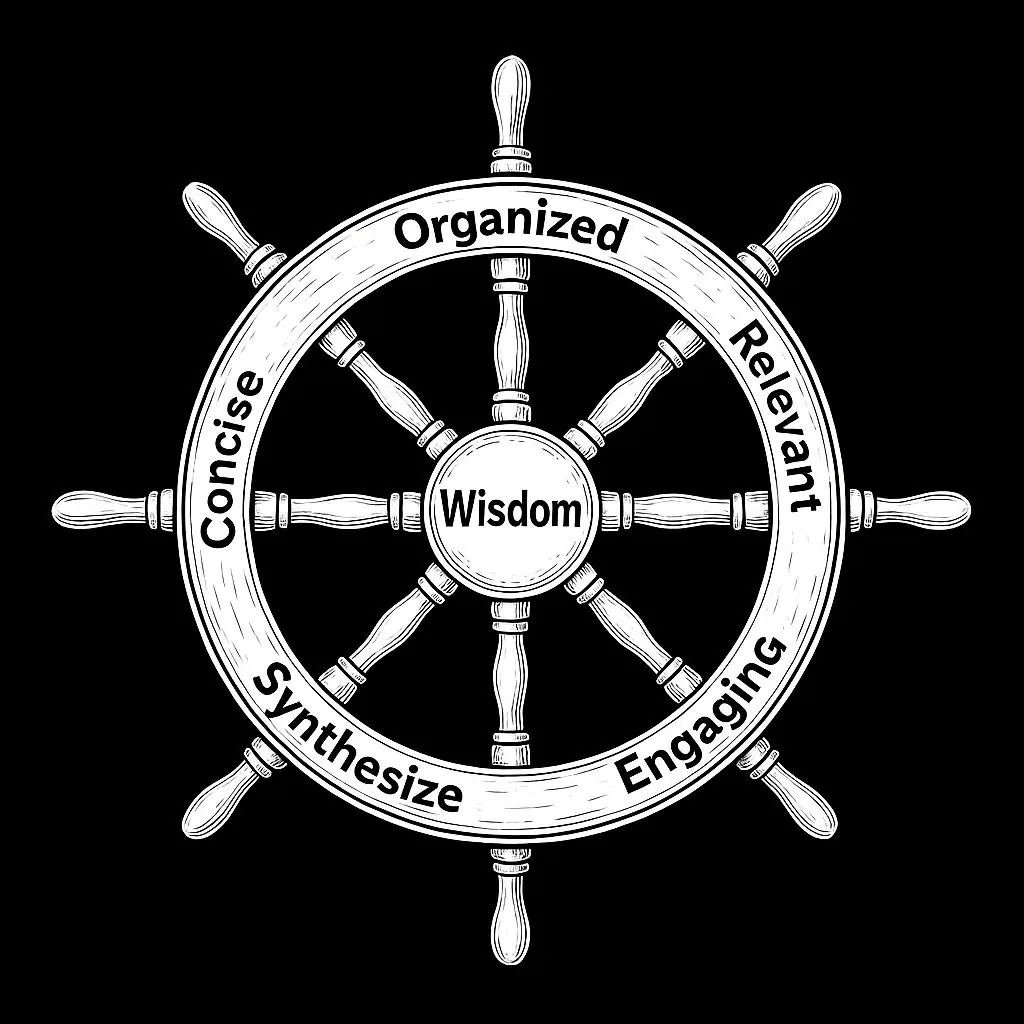
Instead of five pillars in a row or levels in a pyramid, envision CORES as a wheel with wisdom at the center:
The Rim: The five elements (Concise, Organized, Relevant, Engaging, Synthesize) form the outer edge, all equally important, mutually reinforcing. No element is "higher" or more advanced than another. Each strengthens the others.
The Hub: Wisdom occupies the center as the quality that makes everything else meaningful. It's the difference between knowing and understanding, between skill and judgment, between doing and doing well.
The Spokes: Connecting rim to hub, these represent the pathways between practical design principles and the deeper human capacity we're trying to cultivate. They're the integration channels through which tactical decisions connect to the development of wise practitioners.
The Motion: Unlike a static tower, a wheel rolls forward. It's dynamic, adaptive, responsive to terrain. It can change direction. It moves learners toward something that matters.
Why Wisdom Must Be Central
Placing wisdom at the center acknowledges what all great educational frameworks ultimately point toward: we're not trying to produce people who know more or do more. We're trying to cultivate people who understand more deeply, who can navigate complexity and ambiguity, who can hold multiple perspectives simultaneously, who know the limits of their knowledge, and who can connect what they know to what matters.
Wisdom is:
The integration of knowledge with experience. Information becomes wisdom only when tested against reality, when abstract concepts meet actual situations, when theory confronts the beautiful messiness of practice. A student can memorize ethical principles, but wisdom is knowing how those principles feel when they conflict, when the right answer isn't clear, when every choice involves trade-offs.
The recognition of context and nuance. Wisdom understands that the right answer depends on the situation. It resists absolute certainties while maintaining core values. It knows that "it depends" isn't evasion. It's often the beginning of sophisticated thinking. The wise practitioner doesn't just know what works; they understand why it works here but might fail there.
The capacity to hold uncertainty. Wisdom is comfortable saying "I don't know." It can sit with ambiguity, remain open to being wrong, and update beliefs when new evidence appears. It recognizes that expertise means understanding the limits of your expertise, not transcending them.
The connection between knowledge and values. Technical skill without wisdom produces people who can do things brilliantly but can't answer whether they should. Wisdom is the bridge between capability and purpose, between means and ends. It asks not just "can we?" but "should we?" and "for whom?" and "at what cost?"
The cultivation of judgment over time. You can't download wisdom or memorize your way to it. It requires experience, reflection, failure, recovery, and the accumulation of pattern recognition that comes from navigating real problems in real contexts. Wisdom is what remains when the specific facts fade: the deep structure of understanding that transfers across situations.
When we place wisdom at the hub of CORES, we're saying: every element of good design, every cognitive level we engage, every learning experience we create should ultimately serve the development of wise practitioners, not just knowledgeable ones. The framework exists to cultivate wisdom, not the other way around.
The Irony of Frameworks
Here's the beautiful paradox: the ultimate sophistication is knowing that the framework itself is not the goal.
The framework is scaffolding. Wisdom is the building that remains when the scaffolding comes down. It's the internalized understanding of how learning works, what students need, and how to create the conditions for genuine growth and transformation that extends beyond your classroom, beyond their degree, into their lives and work.
This is why both Bloom's Taxonomy and Maslow's Hierarchy have continued evolving over decades. They're not fixed truths but living frameworks that grow as our understanding deepens. The willingness to evolve your own framework is itself an act of wisdom.
From Theory to Practice: The Wheel in Motion
What does this wheel model mean for actual teaching?
Start with wisdom as your north star. Before designing any learning experience, ask: What does wisdom look like in this domain? For a nurse, wisdom means integrating clinical knowledge with human compassion, knowing when to follow protocol precisely and when patient condition requires creative thinking. For an engineer, wisdom means understanding when elegant simplicity serves better than complex sophistication. For a teacher, wisdom means recognizing that the same approach that reaches one student may alienate another. Define wisdom first, then design backward.
Design for integration, not isolation. Don't create separate activities for "concise" and "engaging" and "synthesize." The most powerful learning experiences integrate all elements simultaneously. A well-crafted case study can be concise in setup, organized in structure, relevant to practice, engaging in its complexity, and require synthesis to resolve, all while creating opportunities for students to develop professional judgment and wisdom.
Allow the wheel to roll. Your course will need to emphasize different elements at different points. Early in the semester, you might focus more on organized and concise as students build foundations. Midway, engagement and synthesis intensify as they tackle authentic problems. Near the end, you might create space for reflection that connects their learning to emerging wisdom. Throughout this journey, wisdom remains the center, the purpose toward which everything points.
Make wisdom explicit and valued. Don't assume students will automatically develop judgment from mastering skills. Name it. Discuss it. Model it. Create opportunities to practice it. Share stories of when you've been uncertain, made mistakes, or had to revise your thinking. Ask: "What would a wise practitioner do in this situation? What factors matter most? What are we weighing? What can't we know for certain, and how do we proceed anyway?"
Assess for wisdom, not just competence. Testing whether students can perform skills measures one thing. Assessing whether they can navigate ambiguity, recognize context, adapt to new situations, and make sound judgments measures something deeper. Create assessments that require weighing trade-offs, defending choices in complex scenarios, or reflecting on what they've learned about their own learning. Ask them to articulate not just what they know but how they've changed.
Build in reflection as a practice. Wisdom develops through the cycle of experience and reflection. Build structured opportunities for students to look back on their learning, identify patterns, recognize growth, and articulate insights. What surprised them? What challenged their assumptions? When did they realize they were wrong about something? These moments are where information crystallizes into wisdom.
Living Frameworks
Perhaps this is the deepest insight: creating your own taxonomy or evolving an existing one is itself an act of wisdom. It recognizes that no single framework captures all truth, yet it believes that creating frameworks helps us see more clearly, teach more intentionally, and serve learners more effectively.
The CORES wheel isn't a final answer. It's one interpretation, one way of organizing insights about learning. You might need to add spokes, reimagine the rim, or reconceptualize the hub entirely for your context, your discipline, your students.
That's not a weakness. That's exactly how living frameworks should work.
Because the goal was never to build the perfect tower. It was always to create wheels that help both educators and learners move forward with greater clarity, purpose, and yes, wisdom.
When we design learning experiences that are Concise, Organized, Relevant, Engaging, and ask learners to Synthesize (all while keeping the cultivation of wisdom at the center of every decision) we create more than education. We create transformation.
And transformation, not information, is what our learners' irreplaceable time deserves.
The CORES wheel represents an evolution in educational thinking, from hierarchies to be climbed toward integrated systems to be navigated, from the accumulation of knowledge toward the cultivation of wisdom. When frameworks serve wisdom rather than wisdom serving frameworks, learning becomes not a destination to reach but a way of moving through the world with greater understanding, deeper purpose, and more generous humanity.
Originally published on C.O.R.E Framework.