Is It Worth It? Why Speak-Up Culture Takes Two Conditions, Not One Poster
6 min read
Walk into almost any hospital, clinic, or corporate office and you will find a poster urging employees to “speak up,” “see something, say something,” or “speak your truth.” The intention is good. The effect, too often, is not.
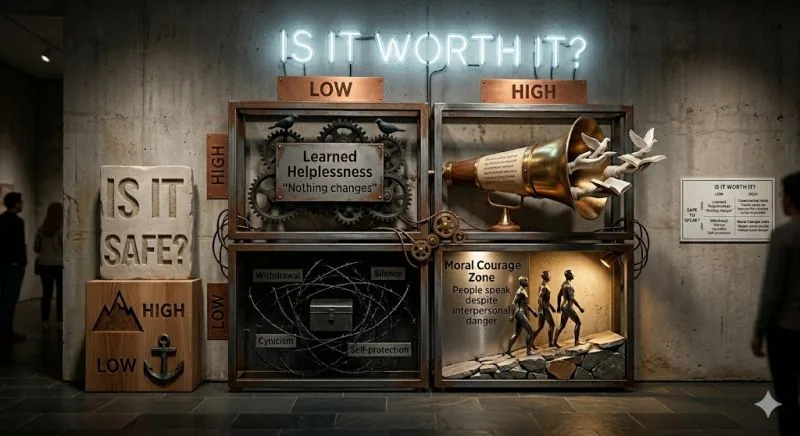
The graphic above makes a simple argument. Before anyone raises a concern, points out a mistake, or suggests a better way, they quietly ask themselves two questions: Is it safe? and Is it worth it? Only when the answer to both is yes do organizations get the steady flow of honest information they claim to want. A poster answers neither question. It only asks employees to take a risk on faith.
The two questions are grounded in research
This is not a slogan. It reflects decades of organizational research. In her review of the employee voice literature, Morrison (2014) identifies two judgments that sit at the center of the decision to speak or stay silent: a safety judgment (will this hurt me?) and an efficacy judgment (will this make any difference?). Employees become more likely to speak as both rise and more likely to stay silent as either falls.
The safety half is well established. Edmondson (1999) introduced team psychological safety as a shared belief that the team is safe for interpersonal risk taking, and in a study of 51 work teams she found it was associated with the learning behaviors that drive performance. Detert and Burris (2007), studying more than 3,000 employees and 223 managers in a restaurant chain, found that managerial openness predicted employee voice, and that the relationship ran through employees’ sense of psychological safety.
The “worth it” half gets less attention, and that is the gap the poster approach falls into. Shedletzky (2023) builds his book Speak-Up Culture around exactly this pairing: people speak up when it is both safe and worth it. Safety without responsiveness is only half a culture.
The four rooms
The graphic divides the workplace into four quadrants. Most organizations will recognize themselves in at least one.
Low safety, low worth: Silence
The lower left panel shows barbed wire, a locked box, and four words: withdrawal, silence, cynicism, self-protection. Here, speaking up is dangerous and pointless. Van Dyne, Ang, and Botero (2003) describe this kind of withholding as defensive silence, driven by fear and self-protection. When Milliken, Morrison, and Hewlin (2003) interviewed 40 employees across industries, most had held back a concern from a supervisor, and the reason cited most often was fear of being labeled negatively and damaging valued relationships.
High safety, low worth: Learned helplessness
The upper left panel is quieter and, in some ways, more corrosive. No one gets punished for speaking up. Nothing happens either. The gears turn, the birds sit, and the sign reads “Nothing changes.” Van Dyne and colleagues (2003) call this acquiescent silence: withholding rooted in resignation rather than fear. Milliken and colleagues (2003) also found that a sense of futility, the belief that speaking up would not change anything, kept people quiet.
There is an important nuance here. Fifty years after the original learned helplessness experiments, Maier and Seligman (2016) concluded that the original theory had it backward. Passivity in response to prolonged, uncontrollable stress is the default. What organisms learn is control. Applied to the workplace, this reframes the leader’s job. Employees do not need to be taught helplessness. They arrive at it naturally whenever their input disappears into a void. What they need is repeated, visible evidence that their voice changes things.
Low safety, high worth: The moral courage zone
In the lower right panel, figures climb upward toward the light despite the danger. These are the people who speak up anyway because the stakes are too high to stay quiet: the nurse who questions a medication order, the therapist who reports an unsafe transfer practice, the employee who flags misconduct. We rightly admire them. But an organization that depends on moral courage has built its safety system on the backs of individuals willing to absorb personal cost. That is not a culture. That is a stroke of luck, and the lucky people often pay for it.
High safety, high worth: Speak-up culture
The upper right panel is the goal: a megaphone releasing doves. Here, people speak because it is safe to do so and because experience has taught them it matters. Voice becomes routine rather than heroic.
Why the poster is worse than nothing
Putting up a “speak your truth” poster without building both conditions is not neutral. It is negligent. It gives leadership a comforting sense of progress while doing nothing to change the calculus employees actually run. Worse, it invites the most conscientious people in the building to step into the moral courage zone, where the risks are real and the organization has built nothing to protect them. The poster throws honest employees to the wolves and then wonders why the rest stay silent.
In healthcare, the cost of that silence is measured in patient outcomes. Okuyama, Wagner, and Bijnen (2014), reviewing the literature on speaking up for patient safety, concluded that health care professionals often hesitate to voice concerns and that this hesitancy can be an important contributing factor to communication errors. Their model of speaking-up behavior among clinicians builds directly on Morrison’s framework of employee voice.
Building both conditions
If safety and worth are the two conditions, leaders have two jobs.
To make it safe, leaders need to respond to bad news, dissent, and mistakes in ways that reward the messenger rather than punish them. Openness is demonstrated in the moment someone brings an inconvenient concern, not in a mission statement. Leaders who acknowledge their own fallibility first make it far easier for others to follow.
To make it worth it, leaders need to close the loop. Every concern deserves a response: what was done, what could not be done, and why. “You said, we did” is more persuasive than any poster, because it provides the one thing that counters default passivity, evidence of control. When the answer is no, explaining the reasoning still demonstrates that the input was heard and weighed.
The question on the wall of the graphic is the one every employee is already asking. The only thing leaders control is the answer.
References
Detert, J. R., & Burris, E. R. (2007). Leadership behavior and employee voice: Is the door really open? Academy of Management Journal, 50(4), 869–884. doi:10.5465/amj.2007.26279183
Edmondson, A. C. (1999). Psychological safety and learning behavior in work teams. Administrative Science Quarterly, 44(2), 350–383. doi:10.2307/2666999
Maier, S. F., & Seligman, M. E. P. (2016). Learned helplessness at fifty: Insights from neuroscience. Psychological Review, 123(4), 349–367. doi:10.1037/rev0000033
Milliken, F. J., Morrison, E. W., & Hewlin, P. F. (2003). An exploratory study of employee silence: Issues that employees don’t communicate upward and why. Journal of Management Studies, 40(6), 1453–1476. doi:10.1111/1467-6486.00387
Morrison, E. W. (2014). Employee voice and silence. Annual Review of Organizational Psychology and Organizational Behavior, 1, 173–197. doi:10.1146/annurev-orgpsych-031413-091328
Okuyama, A., Wagner, C., & Bijnen, B. (2014). Speaking up for patient safety by hospital-based health care professionals: A literature review. BMC Health Services Research, 14, 61. doi:10.1186/1472-6963-14-61
Shedletzky, S. (2023). Speak-up culture: When leaders truly listen, people step up. Page Two. ISBN 978-1-77458-284-8
Van Dyne, L., Ang, S., & Botero, I. C. (2003). Conceptualizing employee silence and employee voice as multidimensional constructs. Journal of Management Studies, 40(6), 1359–1392. doi:10.1111/1467-6486.00384
Originally published on Practical Innovations.