
The Care Equation: Why Better Care Starts With Better Questions
5 min read
Every healthcare organization says it wants to improve quality. We build dashboards, launch initiatives, hire consultants, and roll out new protocols. Yet many of those efforts stall, and the same problems resurface a year later wearing different clothes.
After more than 35 years in clinical practice, education, and consulting, I’ve come to believe the difference between systems that improve and systems that merely change comes down to something deceptively simple. It comes down to how they ask questions, and what happens when those questions get answered.
I’ve tried to capture that idea in a single line:
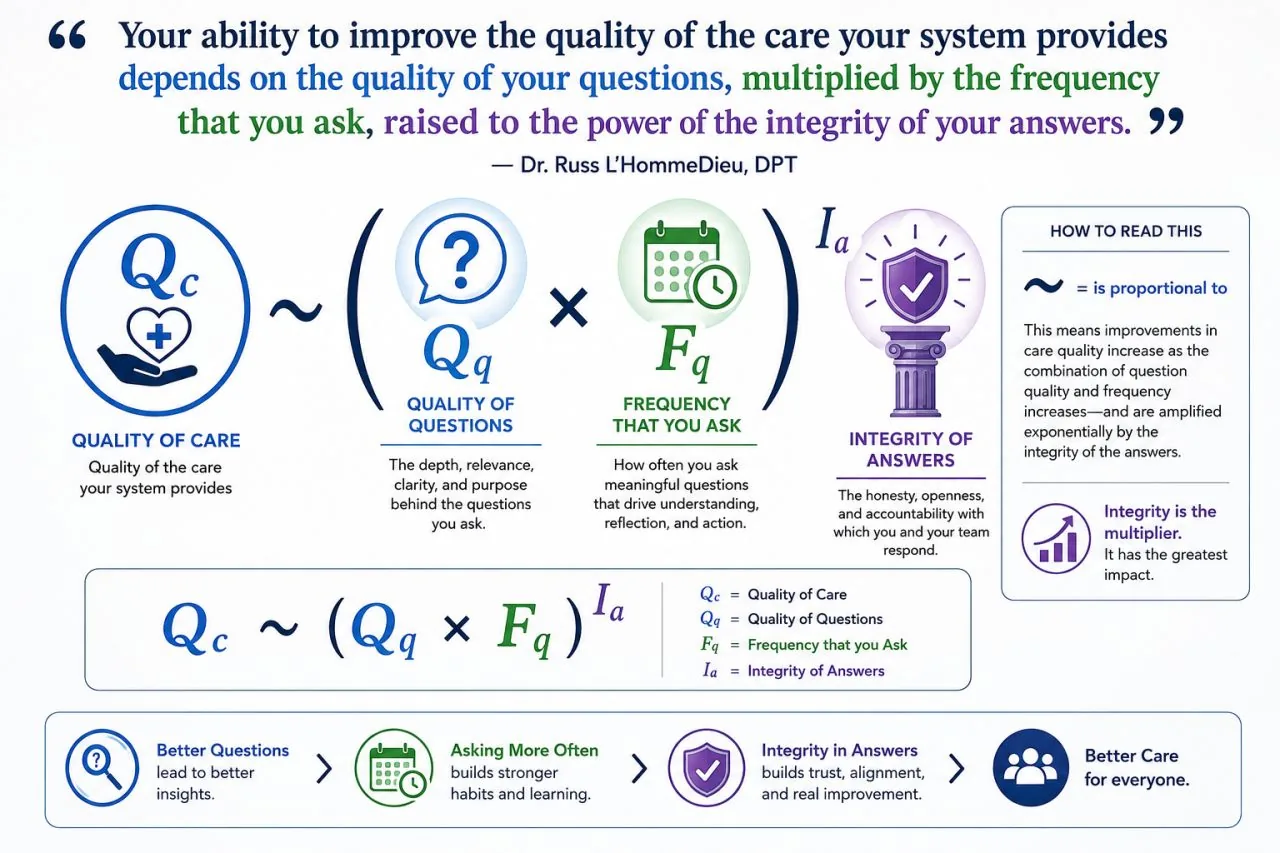
Your ability to improve the quality of the care your system provides depends on the quality of your questions, multiplied by the frequency that you ask, raised to the power of the integrity of your answers.
Or, written as an equation:
Qc ~ (Qq × Fq)Ia
This isn’t meant to be literal math. You won’t plug numbers into it on a Tuesday afternoon. But the structure of the equation says something important about how improvement actually works, so let’s walk through it.
Quality of Questions (Qq)
The first variable is the quality of the questions we ask. Not all questions are created equal.
“Did we meet the documentation deadline?” is a question. So is “What made it hard for our clinicians to document well this week?” The first checks a box. The second opens a door.
High quality questions share a few traits. They are relevant to the work people actually do. They are clear enough that people know what’s being asked. And they carry a genuine purpose: the person asking actually wants to learn something, rather than confirm what they already believe.
Poor questions produce poor information, no matter how often you ask them. A beautifully designed survey that asks the wrong things will generate beautifully formatted nonsense.
Frequency That You Ask (Fq)
The second variable is how often we ask. Here’s where many organizations fall short. They ask excellent questions once a year, in an annual engagement survey or a strategic planning retreat, and then wonder why nothing changes.
Improvement is a habit, not an event. Teams that ask meaningful questions regularly, in huddles, in supervision, in debriefs after a difficult case, build a culture where reflection becomes normal. Problems surface while they’re still small. Learning compounds.
Notice that quality and frequency are multiplied in the equation, not added. That matters. If either one is close to zero, the product collapses. Asking great questions rarely gets you little. Asking shallow questions constantly gets you little too, and it often breeds survey fatigue and cynicism along the way. You need both working together.
Integrity of Answers (Ia)
Then comes the variable that changes everything: the integrity of the answers.
You can ask the right questions at the right frequency, and still get nowhere if the answers aren’t honest. If staff believe that candor will be punished, they’ll tell you what you want to hear. If leaders respond to uncomfortable answers with defensiveness, people learn quickly to stop offering them. If a team answers honestly but nobody is held accountable for acting on what was said, integrity erodes from the other direction.
That’s why integrity sits in the exponent. It doesn’t just add to the result. It amplifies or suppresses everything else.
Think about what an exponent does. When integrity is high, it magnifies the value of every good question you’ve asked. When integrity drops toward zero, something striking happens: any number raised to the power of zero equals one. All of your careful question design, all of your disciplined huddles, all of your survey infrastructure, flattens into a constant. You end up exactly where you started, no matter how hard you worked.
That’s the organizational reality many of us have lived. Lots of activity. No movement.
Integrity Is Built, Not Declared
Integrity of answers isn’t a trait we can demand from individuals. It’s a property of the system. People answer honestly when it is safe to do so, when they trust that their answers will be heard, and when they see that honesty leads somewhere.
This connects directly to what we know about psychological safety and Just Culture. When organizations distinguish between human error, at-risk behavior, and reckless behavior, and respond to each appropriately, people stop hiding mistakes. When leaders model vulnerability by answering hard questions about their own decisions, others follow.
Integrity also runs in both directions. It includes the honesty of the person answering, and it includes the openness and accountability of the person receiving the answer. A leader who asks “What’s getting in your way?” and then does nothing with the response is spending down the organization’s integrity just as surely as someone who shades the truth.
Putting the Equation to Work
So what does this look like in practice? A few places to start:
Audit your questions. Look at the questions your team is regularly asked, in meetings, forms, and surveys. Which ones actually drive understanding or action? Which ones exist only because they always have? Retire the weak ones and sharpen the rest.
Build rhythm, not events. Replace some of the once a year reflection with brief, recurring conversations. Five minutes at the end of a shift asking “What did we learn today?” can outperform a two hour annual retreat.
Protect the answers. Pay close attention to what happens right after someone says something uncomfortable. That moment teaches everyone in the room whether honesty is welcome. Thank people for candor, even when it stings.
Close the loop. When people answer, show them what changed because of it. Nothing builds integrity faster than seeing that an honest answer made a difference.
Better Care for Everyone
The path is straightforward, even if it isn’t easy. Better questions lead to better insights. Asking more often builds stronger habits and learning. Integrity in the answers builds trust, alignment, and real improvement. And the result is better care, for patients, for families, and for the clinicians who deliver it.
Quality isn’t something a system has. It’s something a system keeps discovering, one honest answer at a time.
So here’s my question for you: what’s one question your team should be asking every week that it currently isn’t? And just as important, would you get an honest answer if you asked it?
Dr. Russ L’HommeDieu, DPT
Originally published on Practical Innovations.