Multimedia Learning
5 min read
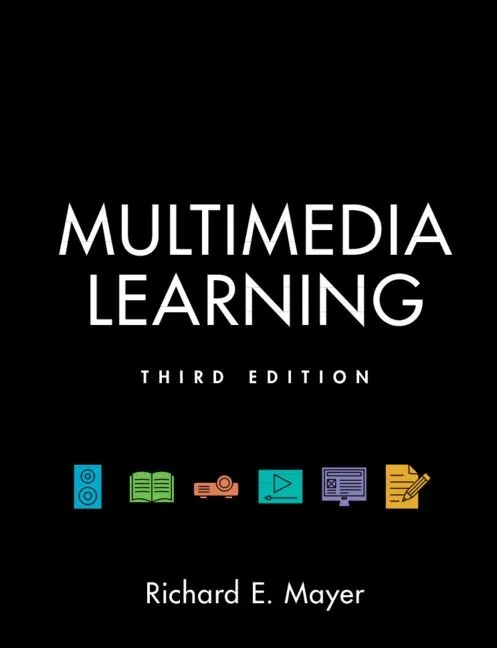
by Richard E. Mayer
Multimedia Learning presents Mayer's cognitive theory of how people learn from words and pictures combined. Based on decades of experimental research, the book provides evidence-based principles for designing effective multimedia instruction. Mayer argues that learning isn't just about what information you present, but how you present it. His 12 principles offer a practical framework for anyone creating digital learning experiences, from simple slides to complex eLearning programs.
Author Credentials/Background
Richard E. Mayer is Distinguished Professor of Psychology at UC Santa Barbara, where he has served since 1975. He received his Ph.D. in psychology from the University of Michigan (1973) and B.A. from Miami University. Mayer received the E.L. Thorndike Award (2000) for career achievement in educational psychology and was ranked the most productive educational psychologist in the world (1997-2001). He has authored over 500 publications including 30 books. He served as President of the Educational Psychology division of the American Psychological Association and Vice President of the American Educational Research Association. His work focuses on applying cognitive science to education, particularly at the intersection of cognition, instruction, and technology.
The Big Idea(s)
- Dual-Channel Processing: People have separate channels for processing visual and auditory information. Effective multimedia uses both channels without overloading either one.
- Limited Capacity: Each processing channel has limited capacity. Designers must be strategic about what information goes where to avoid cognitive overload.
- Active Processing: Learning isn't passive reception. People actively select, organize, and integrate information to build coherent mental models.
- Words + Pictures > Words Alone: The multimedia principle states that people learn more deeply from words and pictures together than from words alone.
- Evidence-Based Design: All principles are grounded in controlled experiments, not intuition. Mayer tested each principle through rigorous research before recommending it.
- Extraneous Load Reduction: Much of instructional design is about eliminating what interferes with learning, not just adding what helps.
Who Needs This Book
- Essential for: Instructional designers, eLearning developers, educational technology specialists, anyone creating digital learning materials
- Highly valuable for: Teachers creating multimedia lessons, corporate trainers, content creators in education
- Useful for: Anyone designing presentations, educational videos, or online courses
If you're putting text on PowerPoint slides or creating any form of digital instruction, you need these principles.
Key Takeaways by Chapter
Chapters 1-2: Introduction and Cognitive Theory of Multimedia Learning: Establishes the three assumptions (dual channels, limited capacity, active processing) and introduces the cognitive theory. Explains how visual and verbal information are processed separately and why this matters for design.
Chapter 3: Multimedia Principle: People learn better from words and pictures than words alone. The principle seems obvious but is often ignored. Presents experimental evidence showing the power of combining modalities.
Chapter 4: Contiguity Principles (Spatial and Temporal): Place related words and pictures near each other in space and time. When text appears far from the relevant image, or narration comes before or after the visual, learners struggle to connect them. Keep them together.
Chapter 5: Modality Principle: Use spoken words with graphics rather than printed text with graphics. This distributes processing across both channels instead of overloading the visual channel. One of the most powerful principles for reducing cognitive load.
Chapter 6: Redundancy Principle: Don't present identical information in multiple formats simultaneously. Narration plus graphics works better than narration plus graphics plus on-screen text saying the same thing. Redundancy creates overload, not reinforcement.
Chapter 7: Coherence Principle: Exclude extraneous material. Every interesting detail, decorative image, or background music that doesn't support the learning goal is a distraction that reduces learning. Less is more when it comes to instructional design.
Chapter 8: Signaling Principle: Highlight the essential material. Use cues (arrows, bold text, highlighting) to direct attention to what matters. Learners shouldn't have to figure out what's important.
Chapter 9: Segmenting Principle: Break complex material into manageable segments that learners can control. People learn better when they can process information in bite-sized chunks at their own pace rather than in one continuous stream.
Chapter 10: Pre-training Principle: Introduce key concepts and terminology before the main lesson. Pre-training primes the learner's cognitive system, making it easier to process the more complex material that follows.
Chapter 11: Personalization and Voice Principles: Use conversational style and human voice rather than formal language and machine voice. People learn better when instruction feels like a conversation with a helpful tutor rather than a lecture from an authority.
Chapter 12: Image Principle: The presence of the instructor's image on screen doesn't necessarily improve learning. High-quality relevant visuals are often more effective than talking-head videos. Use instructor presence strategically to build connection, not as default.
Questions It Provokes
- How much of the "multimedia" I create actually violates these principles?
- Am I using visuals to genuinely support learning or just to make slides look less boring?
- Which of my design choices are based on evidence vs. what I think looks good or what's conventional?
- How much cognitive load am I creating through redundancy, extraneous material, or poor spatial/temporal contiguity?
- If I applied just the coherence principle, how much would I cut from my current materials?
- Am I designing for how people actually learn or how I think they should learn?
- What's the difference between "engaging" multimedia and effective multimedia?
Recommendation Strength
ESSENTIAL for anyone creating digital learning materials of any kind. This is the foundational text for evidence-based multimedia design. The principles are research-tested, immediately applicable, and transformative.
Highly Recommended for educators at all levels. Even if you're just making PowerPoint presentations for class, these principles will dramatically improve student learning.
The book is research-heavy with detailed experimental results. Some readers may find this dense, but it's what makes the recommendations credible. Each principle is backed by multiple studies showing effect sizes. This isn't opinion, it's science. The investment in understanding the research pays off in designing materials that actually work.
Related Resources
- e-Learning and the Science of Instruction (Clark & Mayer): Applies these principles specifically to eLearning design with more practical examples
- Learning as a Generative Activity (Fiorella & Mayer): Extends the work to active learning strategies
- The Cambridge Handbook of Multimedia Learning (Mayer, editor): Comprehensive collection of research in the field
Practical Impact: These principles have become standard in instructional design worldwide. Major eLearning authoring tools build some of these principles into their templates. Corporate training programs, universities, and K-12 schools use these as design standards. The principles work across cultures, ages, and subject matter because they're based on fundamental cognitive architecture, not preferences or trends.
Originally published on C.O.R.E Framework.