The Structure of Scientific Revolutions (1962)
5 min read
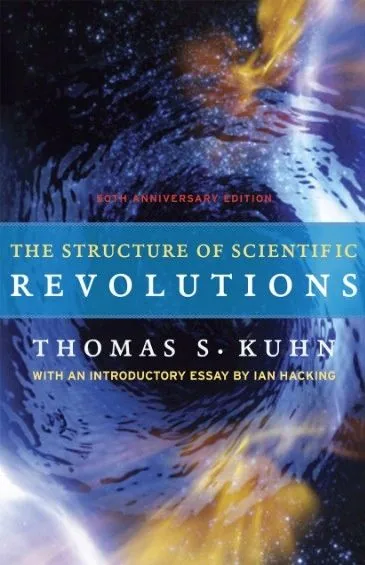
Kuhn fundamentally challenged how we understand scientific progress. Rather than viewing science as a steady accumulation of facts building toward truth, he argued that science advances through revolutionary upheavals where entire worldviews (paradigms) are replaced. The book introduced concepts like "paradigm shift" and "normal science" that have permeated far beyond academia into everyday language, though often stripped of their original meaning.
Author Credentials/Background
Thomas Kuhn earned bachelor's (1943) and master's (1946) degrees in physics at Harvard and obtained a Ph.D. (1949) there in the history of science. He taught at Harvard (1951-56), UC Berkeley (1956-64) where he directed the National Science Foundation project Sources for the History of Quantum Physics, Princeton (1964-79), and MIT (1979-91). His transformation from physicist to historian came in 1947 when struggling to understand Aristotle's Physics, he realized he couldn't comprehend it because his Newtonian training was in the way. He was elected to the National Academy of Sciences (1979) and received the George Sarton Medal (1982). The book sold over a million copies and became one of the most cited academic works of the 20th century.
The Big Idea(s)
- Paradigm: A shared framework of theories, methods, and assumptions that defines what counts as legitimate science in a field at a given time. Not just theories, but an entire worldview.
- Normal Science: Scientists work within established paradigms solving "puzzles" rather than questioning fundamentals. Most scientific work is puzzle-solving, not revolutionary discovery.
- Anomaly and Crisis: When too many observations can't be explained by the current paradigm, the field enters crisis. Anomalies accumulate until they can't be ignored.
- Scientific Revolution: The old paradigm is overthrown and replaced with a fundamentally different one (Ptolemaic to Copernican, Newtonian to Einsteinian). This is not just adding knowledge but changing the rules of the game.
- Incommensurability: Different paradigms are so fundamentally different they can't be directly compared. Scientists before and after a revolution literally see different worlds when looking at the same data.
- Science as Social Process: Scientific truth isn't determined solely by objective criteria but by consensus within a scientific community. Human factors matter.
Who Needs This Book
- Essential for: Anyone studying philosophy of science, history of science, or trying to understand how scientific knowledge develops
- Highly valuable for: Scientists questioning their field's assumptions, innovators trying to create paradigm shifts, educators teaching scientific thinking
- Useful for: Anyone using "paradigm shift" in conversation who wants to understand what it actually means
If you've ever wondered why brilliant scientists resist new ideas or how entire fields can be wrong for centuries, this book explains why.
Key Takeaways by Chapter
Chapter I-II: Introduction and The Route to Normal Science: Pre-paradigm science is chaotic with competing schools. Once a paradigm emerges (like Newton's mechanics), it defines the field and enables productive "normal science." The paradigm isn't just theory but includes exemplary problems and solutions.
Chapter III-IV: The Nature of Normal Science and Normal Science as Puzzle-solving: Most scientists spend careers doing normal science, not revolutionary work. They solve puzzles defined by the paradigm, extending and refining it. This isn't mindless, it's essential for deep understanding. Scientists don't question foundations, they use them.
Chapter V-VII: Anomaly, Crisis, and Response to Crisis: Anomalies are everywhere but usually ignored or explained away. Only when anomalies become too persistent and important does crisis emerge. Crisis breeds insecurity and proliferation of competing approaches. The field becomes "pre-paradigmatic" again.
Chapter VIII-IX: The Response to Crisis and The Nature and Necessity of Scientific Revolutions: Revolutions replace the old paradigm with an incompatible new one. This isn't adding to old knowledge but reconstructing the field on new foundations. Textbooks are rewritten to make the new paradigm seem inevitable, hiding the revolutionary nature of the change.
Chapter X: Revolutions as Changes of World View: After a revolution, scientists see different things when looking at the same instruments. The duck becomes a rabbit. Gestalt shifts occur. Training in the new paradigm literally changes perception, not just interpretation.
Chapter XI-XIII: The Invisibility, Resolution, and Progress of Revolutions: Revolutions are invisible because textbooks present science as cumulative. Winners write history. Resolution comes not through logic but when the old generation retires or dies and the young adopt the new paradigm. Progress doesn't mean getting closer to truth but becoming better at solving puzzles.
Postscript (1969): Kuhn clarifies and defends against critics. Paradigms aren't just theories but "disciplinary matrices." Revolutions aren't irrational but differently rational.
Questions It Provokes
- Is there objective scientific truth or just consensus among scientists?
- If paradigms are incommensurable, can we really say science progresses toward truth?
- How much of my field's "knowledge" is actually just assumptions baked into the current paradigm?
- Am I doing normal science (puzzle-solving) or recognizing anomalies that others ignore?
- What would it take for me to abandon my field's foundational beliefs?
- If revolutionary scientists are often young outsiders, what does that say about expertise and innovation?
- How do paradigm shifts happen in non-scientific fields (politics, business, education)?
Recommendation Strength
ESSENTIAL for anyone in academia, science, or innovation. This is among the most influential books of the 20th century across all disciplines. It fundamentally changed how we think about knowledge creation.
Caution: The book is often misunderstood. "Paradigm shift" in popular usage rarely means what Kuhn meant. Read the actual book, not summaries, to understand the nuance.
The writing is accessible but dense with historical examples. Kuhn assumes familiarity with physics history (Copernicus, Newton, Einstein, quantum mechanics). Worth the effort. The ideas are genuinely revolutionary and will change how you see your own field.
Related Resources
- The Copernican Revolution (Kuhn, 1957): His earlier work applying these ideas to the shift from geocentric to heliocentric astronomy
- Against Method (Feyerabend): More radical take arguing there's no scientific method at all
- Personal Knowledge (Polanyi): Similar emphasis on tacit knowledge and subjective elements in science
- The Logic of Scientific Discovery (Popper): The opposing view that science progresses through falsification, not paradigm shifts
Impact beyond science: Kuhn's ideas transformed sociology, economics, political science, and business. The concept of "disruptive innovation" owes much to paradigm shift thinking. His work legitimized studying science as a human, social activity rather than pure logic.
Originally published on C.O.R.E Framework.