The Feedback Abyss: Using AI Without Losing Your Soul
11 min read
In my previous essay, I introduced the concept of directionality as the fundamental architecture of learning: the idea that what matters most isn't whether you're lecturing or leading a discussion, but rather how information and cognitive work flow between instructor and student.
I argued that transformative feedback requires bidirectional dialogue: Feedback + Uptake + Iteration = Learning.
I described six dimensions of high-impact feedback: directionality, frequency, depth, dialogue type, timeliness, and quality.
All of which sounds great in theory. But here's the problem every educator immediately thinks about: "I have 75 students. Each submitted a 10-page paper. That's 750 pages. How am I supposed to provide the kind of deep, iterative, personalized feedback you're describing without dying?"
This is the feedback abyss. The gap between what we know students need and what seems humanly possible to deliver.
There is an answer. . . and yes, I am talking about AI. This is where things get dangerous. While AI is certainly a road frequently traveled by the apathetic and lazy, it's also a possible tool for the thoughtful educator trying to do the right thing at scale.
AI promises to solve the scale problem. It really can be a workforce multiplier. Upload 75 papers, get 75 sets of feedback, delivered in minutes. It's seductive. It's also potentially catastrophic if done wrong.
Here's what's at stake: the fundamental architecture of learning itself.
When we let AI generate unsupervised feedback, we're not just providing mediocre comments. We're destroying bidirectionality. We're reducing education to unidirectional transmission disguised as dialogue. We're betraying students who trust that their work is being read, considered, and responded to by a human expert who cares about their growth.
But when we use AI thoughtfully (within a clear theoretical framework, guided by explicit principles, with human expertise and judgment at the center), we can actually strengthen the architecture of learning. We can provide more frequent, more detailed, more personalized feedback than we could manage manually. We can maintain the bidirectional exchanges that transform assignments from assessments into learning tools.
The technology is a tool. The question is whether we wield it wisely.
What AI Is Actually Great At: The Real Superpowers
Here's the paradigm shift: AI shouldn't replace you in the feedback loop. It should amplify your capacity to see patterns, make connections, and engage more deeply than you could without it.
AI has seven genuine superpowers for educational feedback. Understanding these helps you deploy AI strategically rather than generically.
Superpower 1: Pattern Recognition Within Groups
Upload 75 papers to AI and ask: "What are the three most common strengths? The three most common weaknesses? What misconceptions appear across multiple submissions?"
AI can answer these questions in minutes, giving you diagnostic information about your entire class before you write a single individualized comment.
Why this matters:
You can address systematic gaps through additional instruction (a mini-lecture or class discussion) before students revise. This prevents you from explaining the same concept 18 times individually.
You can adjust your rubric or feedback emphasis based on where students actually are in relation to the goals and skills expected following your instruction.
You can see what you taught effectively and what needs reteaching.
Example: AI reveals "70% of students proposed data collection methods without considering feasibility constraints." You create a brief video addressing feasibility for the whole class. Now your individual feedback can build on shared foundation rather than starting from scratch with each student.
Superpower 2: Pattern Recognition Across Assignments (Same Learner)
AI can track individual student trajectories across multiple assignments, noting consistent strengths and recurring challenges.
Why this matters:
You can provide developmental feedback that shows students their arc of learning: "This is the third assignment where your literature integration has been excellent, but your methodology explanation remains underdeveloped. Let's focus specifically on methodology this cycle."
You can identify when students are stuck in the same pattern versus making genuine progress.
You can celebrate specific growth: "In September, you struggled with stakeholder analysis. Now it's a strength. That's real development."
The human requirement: AI can identify patterns, but you must interpret what they mean pedagogically and decide how to respond. Is the recurring weakness a conceptual gap? A motivational issue? A developmental trajectory that needs more time? AI flags patterns. You provide meaning.
Superpower 3: Raw Information Processing and Cross-Referencing
AI can simultaneously hold your entire course (syllabus, readings, lecture notes, discussion summaries) and compare it against student work.
Why this matters:
Feedback becomes contextually rich: "Your analysis here resonates with the Smith article from Week 3, but consider how it conflicts with the data we examined in Thursday's discussion."
You can identify when students are missing connections you expected them to make: "This would be stronger if you'd applied the framework from the Johnson reading."
You can spot when students are drawing on materials in sophisticated ways you might have missed when exhausted.
Example: AI cross-references a student's evaluation plan against your rubric, course readings, and previous class discussions, then generates draft feedback that references specific sources and concepts. You review to ensure accuracy and add your pedagogical judgment about priorities.
The human requirement: You must verify that AI's connections are accurate and meaningful, not just pattern-matched superficially. AI can find textual similarities. You determine whether the connection represents genuine understanding or coincidence.
Superpower 4: Current Research Integration
AI can search recent literature and integrate cutting-edge research into feedback, keeping discussions current and academically rigorous.
Why this matters:
Students encounter the field as it exists now, not as it existed when you learned it.
Feedback can point to very recent developments, for example: "This approach was standard practice, but Chen et al. (2024) just published findings that challenge this assumption."
You model how professionals stay current: continuously engaging with emerging research.
This can lead to genuine academic discovery for both you and students, as AI surfaces connections to literature you hadn't encountered.
Example: A student proposes a community-based evaluation approach. AI identifies three recent papers (2023-2024) applying similar methods in refugee communities, which directly relates to this student's context. You review the papers, determine relevance, and incorporate them into feedback with appropriate framing.
The human requirement: You must evaluate the quality and relevance of AI-suggested research. Not all recent publications are high-quality. Not all connections are meaningful. You exercise scholarly judgment about what's worth incorporating.
Superpower 5: Consistency and Fatigue Resistance
AI doesn't get tired. The 75th paper receives the same careful attention as the 1st. The quality of analysis doesn't degrade at 11 PM or after a long day of teaching.
Why this matters:
This has profound equity implications. Students shouldn't receive worse feedback simply because they're at the bottom of your grading stack when you're exhausted.
Every student gets comprehensive initial analysis. You then apply human judgment consistently rather than variably based on your energy level.
You catch errors and identify strengths across all papers with equal attention, then personalize based on pedagogical priorities rather than stamina.
Example: At paper 47, you're tired. You might miss a sophisticated argument buried in paragraph 8. AI flags it: "This paper makes an implicit connection between social capital theory and community resilience." Now you can acknowledge and build on that thinking in your feedback.
The human requirement: AI provides consistent analysis, but you must still apply consistent pedagogical judgment. Consistency in processing doesn't automatically create consistency in teaching. You're responsible for ensuring your standards remain stable across all students.
Superpower 6: Speed Enabling Iteration
AI's speed doesn't just save time. It fundamentally changes what's pedagogically possible by making multiple revision cycles feasible within a single term.
Why this matters:
Transformative feedback requires iteration: Feedback + Uptake + Iteration = Learning. But iteration requires fast turnaround. Students need feedback while the work is still fresh in memory.
24-48 hour turnaround on initial feedback makes Week 8 draft → Week 10 revision → Week 12 final genuinely achievable.
Three rounds of progressively sophisticated dialogue become sustainable where one round was previously exhausting.
Example: Without AI, providing substantive feedback on 25 papers takes 10-12 hours. That realistically happens once per major assignment. With AI assistance cutting time to 5-6 hours, you can provide feedback on initial drafts, respond to revision plans, and give substantive comments on revised work. The speed enables the pedagogical structure that makes learning possible.
The human requirement: Speed creates opportunity, but you must design assignments to capitalize on it. Structure revision cycles into your syllabus. Build response and iteration into grade calculations. Create explicit expectations for student uptake. Speed alone doesn't create dialogue. Intentional design does.
Superpower 7: Revision Uptake Tracking
AI can analyze what students actually changed between drafts versus what feedback they ignored or misunderstood. This provides valuable diagnostic data about the effectiveness of your feedback itself.
Why this matters:
You learn whether students understood your guidance. If 15 students ignored the same feedback point, maybe it wasn't clear.
You can identify students who need additional support: those who struggled to interpret feedback or didn't know how to implement suggestions.
You can celebrate specific uptake: "You addressed every major point from my feedback and made thoughtful choices about how to revise. That's exactly the kind of responsive learning professionals do."
Example: AI compares draft 1 to draft 2 and reports: "Student addressed stakeholder analysis comments (added 3 paragraphs), ignored feasibility concerns (no changes to timeline), partially addressed ethical considerations (added IRB mention but didn't address power dynamics)." This tells you what to emphasize in round 2 feedback and whether your initial guidance was interpretable.
The human requirement: Tracking changes isn't the same as understanding why changes were made. You must engage with students about their revision process. Did they ignore feedback because they didn't understand it? Because they disagreed? Because they ran out of time? The data starts the conversation. You conduct the dialogue.
The Critical Pattern: AI Processes, You Decide
Notice what's consistent across all seven superpowers: AI handles information processing at scale that would be impossible manually. You provide the judgment, interpretation, and pedagogical wisdom that transforms raw analysis into teaching.
The Irony: AI Needs Dialogue Too
One-pass interactions with AI produce AI slop. Just like one-pass interactions with students produce surface learning.
If you prompt AI once with "Give me feedback on this paper" and send whatever it generates, you get generic, shallow, often inaccurate commentary. It's the educational equivalent of asking a student "What did you learn?" and accepting their first sentence as deep reflection.
Quality AI assistance requires iterative prompt engineering: an ongoing dialogue where you progressively refine what you're asking for, review what you get back, identify gaps and problems, and prompt again with greater specificity.
This isn't just technical skill. It's pedagogical translation. You're teaching the AI what you actually need, just as you teach students what good work actually looks like.
The HUMAN Framework: Your Guide Through the Abyss
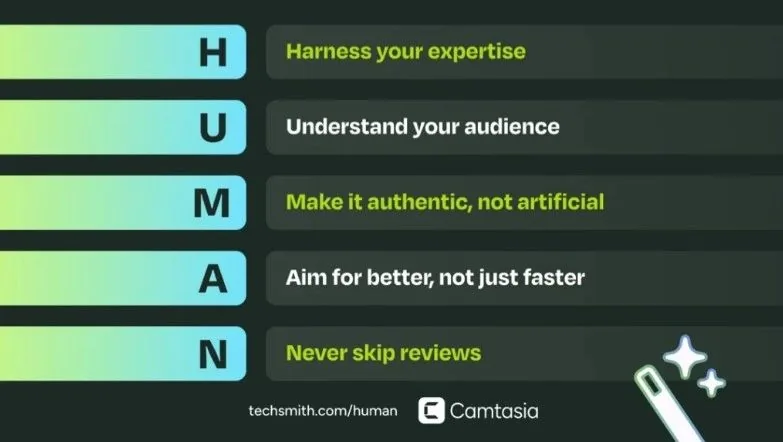
To use AI responsibly and effectively in providing feedback, we need guiding principles that keep educators centered in the process. The HUMAN Framework, developed by Matt Pierce (opens in a new tab), Learning & Video Ambassador at TechSmith Corporation, provides exactly that.
Introduced in October 2025 through The Visual Lounge podcast (Episode 262: "Avoiding AI Slop: Best Practices from the Human Framework") (opens in a new tab), this framework emerged as a response to the flood of auto-generated content lacking genuine value, what Pierce calls "AI slop." Though originally designed for video and content creation, the framework translates powerfully to educational feedback.
The framework consists of five principles that serve as both guardrails and aspirations.
H: Harness Your Expertise
The principle: Use AI to amplify your professional knowledge, not replace it.
AI aims for the common denominator, the generalized response. You bring what AI cannot: disciplinary expertise, pedagogical judgment, understanding of developmental trajectories, and knowledge of what matters most in your field. AI generates starting points. You provide the expertise that transforms generic commentary into genuine teaching.
In practice: Add disciplinary context that AI lacks. Connect feedback to course materials and discussions. Exercise pedagogical judgment about what this student needs right now. Make visible the expert thinking that students need to internalize.
U: Understand Your Audience
The principle: AI doesn't know your students. You do.
Generic feedback might be technically correct but pedagogically wrong if it doesn't match where your students actually are. You understand their backgrounds, developmental levels, past performance, struggles, and strengths. This knowledge must shape every piece of feedback.
In practice: Maintain awareness of each student's trajectory. Adjust framing based on developmental level. Prioritize feedback based on individual capacity for uptake. Connect assignments to students' professional contexts and experiences. Calibrate challenge and support to match readiness.
M: Make It Authentic, Not Artificial
The principle: AI-generated feedback should sound like you, not like a robot.
Students can tell the difference between genuine engagement and automated responses. Authenticity isn't just about tone. It's about demonstrating that a real human read their actual work and cared enough to respond as an individual, not as a processing system.
In practice: Edit AI drafts to sound like your actual voice. Reference specific elements of their work, not generic placeholders. Connect to previous conversations and disclosed experiences. Show genuine enthusiasm or concern where warranted. Acknowledge effort and struggle when you see it. Make students feel seen, not processed.
A: Aim for Better, Not Just Faster
The principle: The goal isn't to speed through grading. The goal is to provide better feedback that leads to better learning.
Speed matters for timeliness, but quality matters for learning. AI should help you optimize for both, not sacrifice one for the other. Use saved time to deepen engagement, not just to finish faster.
In practice: Let AI handle pattern recognition, initial drafts, tracking, and logistics. Use your saved time for sophisticated pedagogical work: determining priorities, asking generative questions, providing calibrated encouragement, modeling expert reasoning, and creating iterative cycles. Before sending feedback, ask: "Is this better than what I could have done without AI, or just faster?"
N: Never Skip Reviews
The principle: Always review AI-generated content before sending it to students. Always. No exceptions.
AI makes mistakes. It hallucinates. It misunderstands context. You're the quality control. You're accountable for what goes out under your name. Your credibility, your students' trust, and the quality of learning all depend on this review step.
In practice: Verify accuracy. Catch references to nonexistent content. Ensure alignment with your rubric and standards. Check that tone is appropriate. Confirm connections to course material are valid. Ensure feedback is actionable and appropriately prioritized. Add necessary nuance that AI missed. One pass by a competent educator transforms generic commentary into genuine teaching.
When you combine AI's processing power with human expertise through iterative prompting and the HUMAN Framework, you can provide feedback that's simultaneously more comprehensive, more personalized, more current, and more pedagogically sophisticated than either could achieve alone.
But only if you refuse to treat AI as a one-pass answer machine.
Only if you engage in genuine dialogue with your tools so you can create genuine dialogue with your students.
Only if you stay in the driver's seat.
Originally published on C.O.R.E Framework.