
The Four Questions That Change Everything
5 min read
In previous posts, we explored how the quality of your questions, multiplied by the frequency you ask them, raised to the power of the integrity of your answers, determines the power of your outcomes (opens in a new tab). This formula applies not only to problem-solving and professional growth but also to something deeply personal: how we manage our emotional lives.
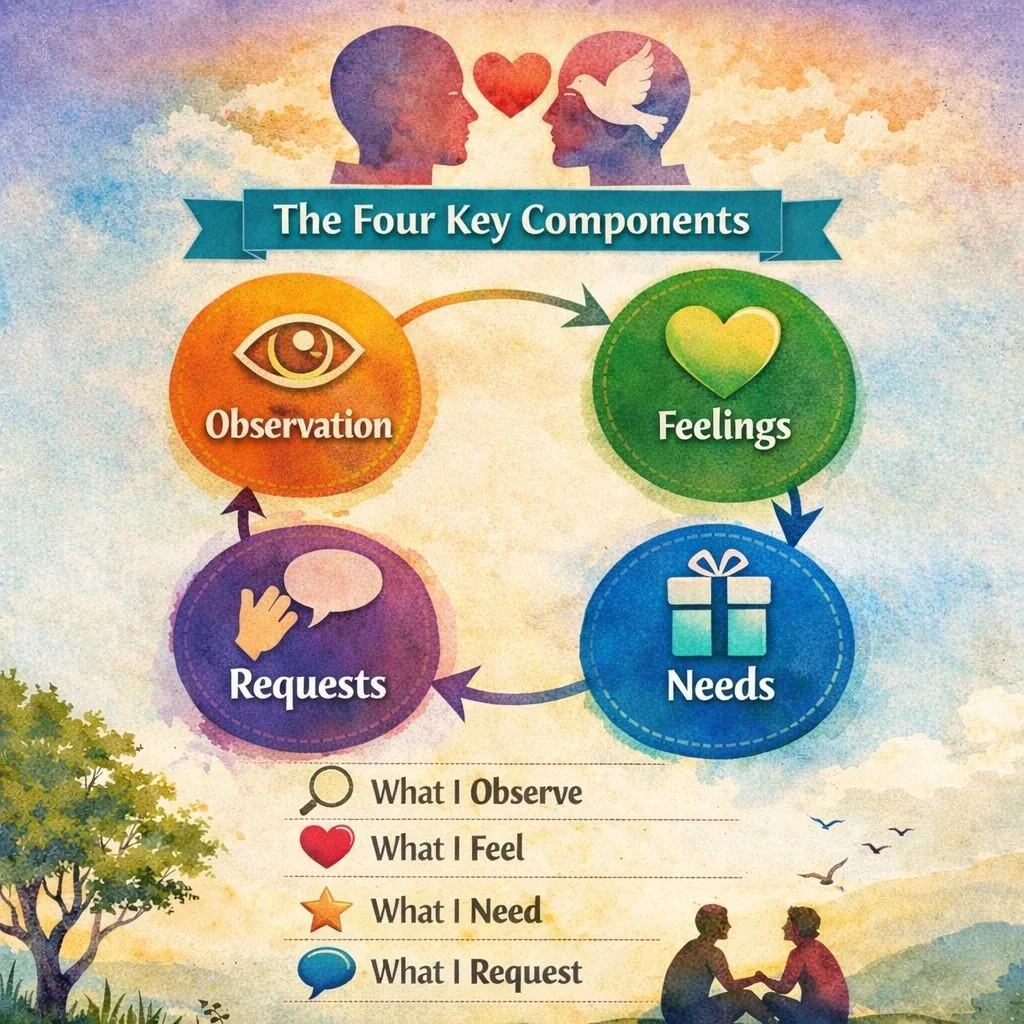
Marshall Rosenberg's Nonviolent Communication (NVC) offers four questions that embody this formula with remarkable precision. These questions can transform how we experience and respond to difficult emotions, moving us from reactivity to clarity, from conflict to connection.
The Four Questions
When emotions arise (especially the difficult ones), NVC invites us to pause and ask:
- What am I observing?
- What am I feeling?
- What am I needing?
- What am I requesting?
Each question builds on the last, creating a pathway from raw experience to purposeful action.
Quality: Why These Questions Matter
These are not vague or superficial questions. They are precise instruments designed to separate what actually happened from the stories we tell ourselves about it.
Consider the difference between "My colleague disrespected me" and "My colleague interrupted me twice during the meeting." The first is interpretation wrapped in judgment. The second is observation. This distinction matters because our emotional responses often stem not from events themselves but from the meanings we assign to them.
The question "What am I feeling?" pushes us deeper. Many people, when asked how they feel, respond with thoughts disguised as feelings: "I feel like you don't care" or "I feel that this is unfair." True feelings (frustration, sadness, anxiety, relief) connect us to our humanity. Pseudo-feelings keep us trapped in judgment.
The third question, "What am I needing?", reaches the root. Beneath every difficult emotion lies an unmet need: for respect, for autonomy, for safety, for meaning. When we identify the need, we stop being victims of circumstance and become agents of our own wellbeing.
The final question, "What am I requesting?", moves us toward action. Not demands. Not manipulation. Clear, concrete, positive requests that honor both our needs and the autonomy of others.
Frequency: The Practice of Returning
As we explored in the inquiry mindset framework, asking a powerful question once is not enough. Emotional mastery develops through repetition. Each time you return to these four questions during an emotional challenge, you strengthen neural pathways associated with reflection, self-regulation, and empathy.
This is not about suppressing emotions or analyzing them into oblivion. It is about creating space between stimulus and response. Viktor Frankl wrote that in this space lies our freedom to choose. These four questions help us find that space and use it wisely.
The questioning mindset, approaching our inner experience with curiosity rather than judgment, transforms emotional management from a battle into an exploration. Instead of asking "Why am I so angry?" (a question that often leads to rumination and self-criticism), we ask "What need of mine is not being met right now?" This subtle shift opens doors that judgment keeps closed.
Integrity: The Courage to Answer Honestly
Here is where the exponent in our formula does its powerful work. The four questions only help if we answer them with integrity.
Integrity in this context means acknowledging what we actually feel, not what we think we should feel. It means admitting our real needs, even when they seem vulnerable or inconvenient. It means making requests without hidden agendas or manipulative intent.
This requires what Kristin Neff calls self-compassion: the willingness to meet our own experience with kindness rather than harsh judgment. When we answer these questions honestly, we often discover that beneath our anger lies hurt, beneath our frustration lies longing, beneath our anxiety lies a deep wish for safety or acceptance.
Application: A Practical Example
Imagine you receive critical feedback on a project you worked hard on. Your chest tightens. Your mind races with defensive thoughts.
Pause. Ask the questions.
What am I observing? My supervisor said the report needed significant revisions and highlighted three sections that missed the mark.
What am I feeling? Disappointed. Embarrassed. Perhaps afraid.
What am I needing? Recognition for my effort. Clarity about expectations. Confidence that I can succeed in this role.
What am I requesting? I could ask my supervisor for a brief meeting to discuss the feedback in more detail so I can understand exactly what would make the next version stronger.
Notice what happened. The same situation, the same feedback, but a completely different internal experience. The questions did not change the external reality. They changed your relationship to it.
Conclusion
The power of your emotional outcomes is determined by the quality of the questions you ask yourself, multiplied by the frequency you ask, raised to the power of the integrity of your answers.
Rosenberg's four questions give us a template for quality. Daily practice gives us frequency. And the courage to answer honestly, even when the truth is uncomfortable, gives us integrity.
This is not a formula for eliminating difficult emotions. It is a formula for transforming our relationship with them, moving from reactivity to wisdom, from isolation to connection, from suffering to growth.
References
Brown, K. W., & Ryan, R. M. (2003). The benefits of being present: Mindfulness and its role in psychological well-being. Journal of Personality and Social Psychology, 84(4), 822–848.
Kashdan, T. B. (2009). Curious? Discover the missing ingredient to a fulfilling life. HarperCollins.
Neff, K. D. (2011). Self-compassion: The proven power of being kind to yourself. William Morrow.
Rosenberg, M. B. (2015). Nonviolent Communication: A language of life (3rd ed.). PuddleDancer Press.
Originally published on C.O.R.E Framework.