The Mentor Mindset
4 min read
Fostering Growth Through High Expectations and High Support
In my years of mentoring and coaching, I have seen a persistent misconception: that effective mentoring is a choice between using the “carrot” or the “stick.” The reality, as both research and experience reveal, is far more nuanced. To truly bring out the best in people, especially young people, we must blend high expectations with high support. This combination lies at the heart of what is called the Mentor Mindset.
Understanding the Four Quadrants
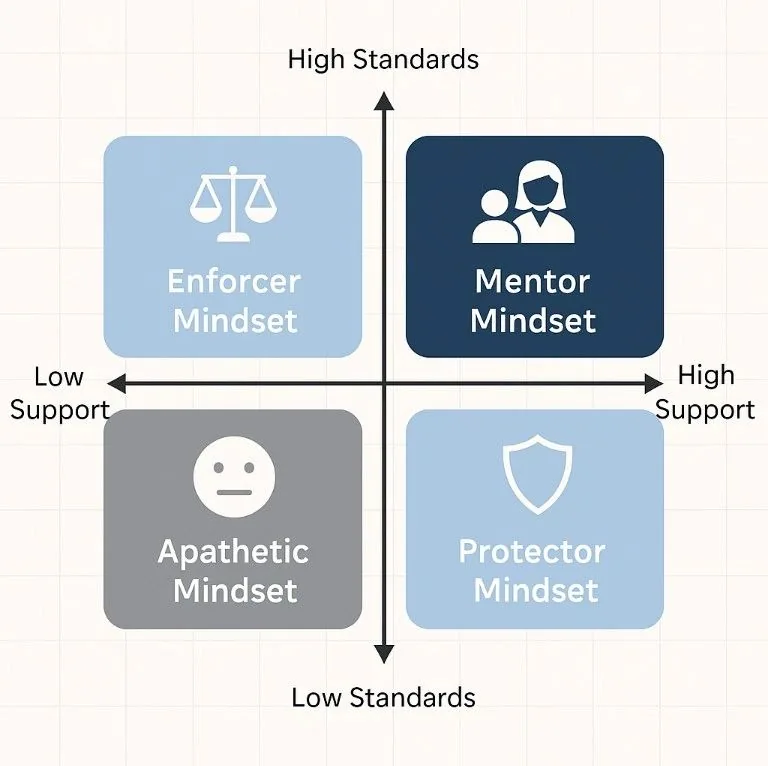
Picture a simple two-by-two grid. One axis represents expectations, the other represents support. When both expectations and support are high, we are in the Mentor Mindset, where people are challenged to grow but are also given the tools, encouragement, and guidance they need to succeed. When expectations are high but support is low, we enter the Enforcer Mindset. Here, the focus is on results, but the necessary encouragement and resources are lacking. If expectations are low and support is high, the Protector Mindset emerges. In this space, people feel cared for but are not stretched to reach their potential. Finally, when both expectations and support are low, we see the Apathetic Mindset, which can lead to disengagement and stagnation. Research from David Yeager (2023) and Carol Dweck (2006) consistently shows that the Mentor Mindset produces the most lasting growth and motivation. This is because it blends accountability with belief in a person’s capacity to rise to a challenge.
Why Mindset Matters More Than Trait
I use the term “mindset” rather than “trait” because a mindset is something that can be learned, adapted, and refined. Traits are often seen as fixed and unchangeable. Mindsets, however, can shift with new insights, experiences, and deliberate practice. No one is born a mentor. We grow into this role through intentional reflection, experimentation, and the willingness to learn from both successes and failures.
Anchoring Leadership in Purpose
Purpose is the fuel that makes high expectations feel meaningful rather than punitive. Without a compelling “why,” high standards can quickly feel like a burden. When we connect expectations to a shared mission or to a bigger story about why the work matters, we inspire commitment rather than compliance. Damon, Menon, and Bronk (2003) found that young people with a strong sense of purpose are more resilient, persistent, and engaged, even in the face of challenges.
The Power of Genuine Questions
Mentors guide with curiosity as much as with direction. Asking genuine, open-ended questions communicates respect for the mentee’s perspective and invites them to think critically. This not only deepens their engagement but also signals trust in their ability to find solutions. When people feel trusted to wrestle with ideas and problems, they are more invested in the outcome.
Communicating Intent Through WISE Feedback
One of the most effective approaches for maintaining motivation while offering constructive feedback is WISE feedback, developed by Yeager and colleagues (2014). WISE feedback combines four elements: warmth, a clear articulation of high standards, assurance of the person’s capability to meet those standards, and specific guidance on how to improve. This approach prevents feedback from being interpreted as a personal attack and instead frames it as an expression of belief in the person’s potential.
Implementing the Mentor Mindset
Bringing the Mentor Mindset to life requires intentional action. The first step is to clarify both your standards and the support you will offer. Expectations should be specific and measurable, and supports should be equally tangible—resources, training, regular feedback, and opportunities for practice. Embedding purpose into daily conversations is another essential step. Rather than relying on generic motivational slogans, connect tasks to real-world impacts and personal growth goals. Modeling curiosity and continuous learning is also vital. Share your own growth process, including mistakes and what you have learned from them. This normalizes the idea that growth is a journey rather than a fixed state. Make WISE feedback a regular practice, not just something reserved for annual reviews. Frequent, supportive, and actionable feedback creates a steady rhythm of improvement. Finally, create opportunities for reflection. Regular check-ins, journaling prompts, or discussion sessions give mentees space to process their experiences, identify patterns, and set their own next steps.
Conclusion
The Mentor Mindset is not just a leadership style. It is a daily practice of balancing challenge with care, direction with dialogue, and standards with empathy. When we root our leadership in purpose, ask genuine questions, communicate our intent clearly, and provide WISE feedback, we create an environment where people can flourish, not just meet expectations.
References
Damon, W., Menon, J., & Bronk, K. C. (2003). The development of purpose during adolescence. Applied Developmental Science, 7(3), 119–128. https://doi.org/10.1207/S1532480XADS0703\_2 (opens in a new tab)
Dweck, C. S. (2006). Mindset: The new psychology of success. Random House.
Yeager, D. S. (2023). 10 to 25: The science of motivating young people. HarperCollins.
Yeager, D. S., Purdie-Vaughns, V., Garcia, J., Apfel, N., Brzustoski, P., Master, A., ... & Cohen, G. L. (2014). Breaking the cycle of mistrust: Wise interventions to provide critical feedback across the racial divide. Journal of Experimental Psychology: General, 143(2), 804–824. https://doi.org/10.1037/a0033906 (opens in a new tab)
Originally published on C.O.R.E Framework.