How Every Child Can Thrive by Five | Molly Wright | TED
5 min read
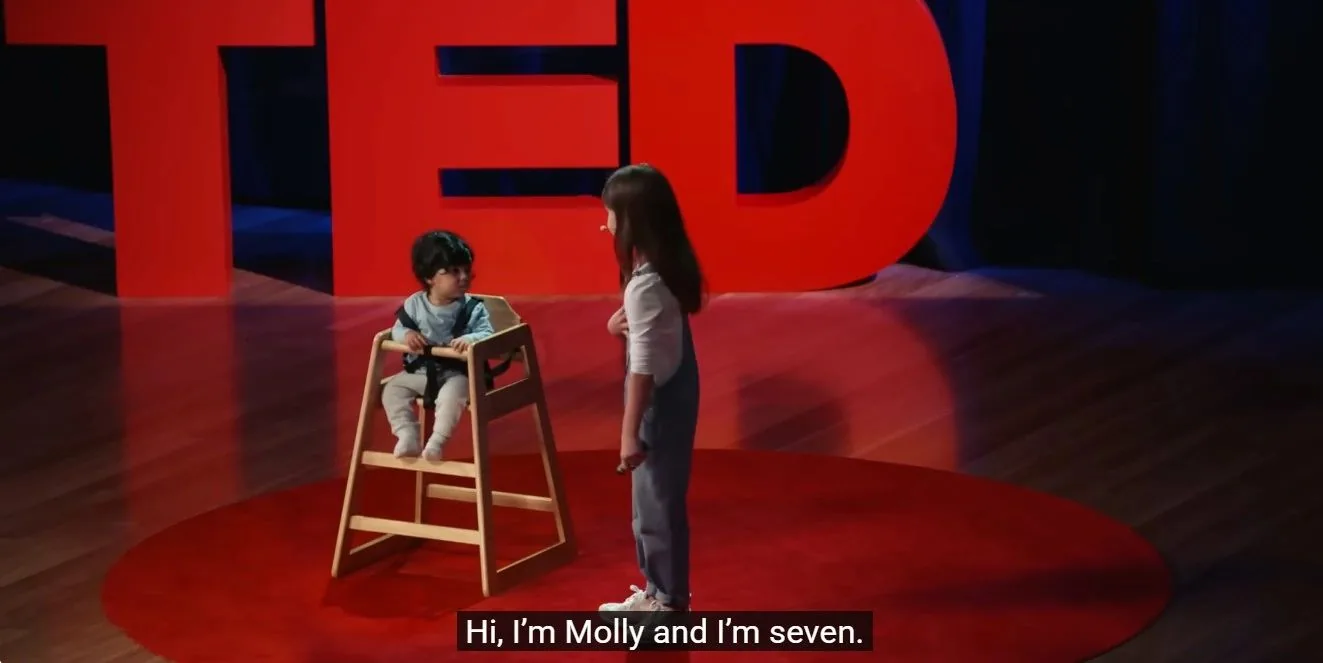
Molly Wright was a 7-year-old Grade 2 student from Queensland, Australia when she delivered this talk, making her one of the youngest TED speakers in history. She is an aspiring wildlife warrior, performer, and budding social activist who, with the help of her parents, runs "Molly's Wildlife Warriors" - a group of 40 children who raise awareness and funds for Currumbin Wildlife Hospital Foundation in Queensland. This TED Talk was commissioned by the Minderoo Foundation (one of Australasia's largest philanthropic organizations) through their Thrive by Five initiative, in collaboration with UNICEF as the global distribution partner, and directed by acclaimed filmmaker Michael Gracey (director of The Greatest Showman). The talk became the most popular TED Talk of 2021, with over 50 million views across all platforms and has been translated into 33 languages.
WATCH THE VIDEO HERE (opens in a new tab)
Big Ideas
Molly delivers a powerful, scientifically-backed message about early childhood brain development through live demonstrations with 1-year-old Ari and his father Amarjot:
The Critical Importance of the First Five Years
- A baby's brain almost doubles in volume during the first year of life
- By age 7, the brain is almost 90% the volume of an adult brain
- The brain develops faster in early years than at any other time in life
- It can create up to one million neural connections every second
- Learning begins even before birth, from inside the mother's womb
The Top Five Needs for Healthy Development
- Connecting
- Talking
- Playing
- A healthy home
- Community
"Serve and Return" - The Key Interaction PatternMolly introduces the scientific concept of "serve and return" as the foundation for healthy brain development:
- Copycat games build imagination and empathy (demonstrated with Ari mimicking facial expressions)
- Naming games build vocabulary and attention (Amarjot pointing and saying "Daddy, Ari, Daddy, Ari")
- Peekaboo builds memory and trust
These simple interactions:
- Build and strengthen relationships and mental health
- Teach critical life skills: making friends, taking tests, getting jobs, starting families
- Must happen "early and often"
The Impact of DisconnectionMolly demonstrates what happens when connection is withdrawn - the "still face" experiment where Amarjot stops responding to Ari. This powerful moment shows:
- Children are hardwired to seek meaningful connections
- Lack of response causes confusion and stress
- Adults' device usage can interrupt critical developmental interactions
- The lifelong impact if childhood consistently lacks connection
The Power of Positive Relationships
- Strong bonds with adults give children confidence to try new things, explore, and "be a kid"
- Ari recovered quickly from the disconnection because his relationship with his dad is usually strong
- The message: every moment together is an opportunity to connect, talk, and play
Implications for Educators
Understanding Developmental Foundations:
- Higher education educators work with students whose foundational brain architecture was shaped in those first five years
- Students' ability to form relationships, manage stress, focus attention, and persist through challenges all stem from early childhood experiences
- Understanding this helps educators approach student struggles with greater empathy and context
Creating Connection in the Classroom:
- The "serve and return" principle applies at all ages - students need responsive, engaged interactions
- Faculty presence and genuine engagement matter as much for college students as for toddlers
- The parallel to Molly's "device disconnection" demonstration: students know when professors are mentally checked out or distracted
Supporting Non-Traditional and At-Risk Students:
- Molly acknowledges "not all kids are as lucky" - some students arrive at higher education without secure early attachments
- These students may struggle more with trust, connection, and seeking help
- Educators can become part of the network of positive adult relationships that help students thrive
- Understanding trauma-informed pedagogy becomes critical
The Role of Play and Interaction:
- Active learning, discussion, and collaborative work aren't just pedagogical preferences - they align with how brains are wired to learn through interaction
- Lecture-only formats miss opportunities for the "serve and return" that deepens learning
- Creating space for students to "play" with ideas, make mistakes, and receive responsive feedback mirrors healthy developmental patterns
Faculty-Student Relationships:
- The talk's emphasis on connection reinforces the research on faculty-student relationships as critical to retention and success
- Simple acts of recognition, responsiveness, and genuine interest can be transformative
- Students, especially first-generation college students, need adults who believe in their potential
Social-Emotional Learning Isn't Just for K-12:
- College students are still developing (brains continue maturing into the mid-20s)
- Teaching resilience, emotional regulation, and relationship skills remains relevant
- Creating a "healthy home" in the classroom through community-building and inclusive practices
Implications for Parent Education Programs:
- Higher education institutions with education, social work, nursing, or child development programs should integrate this evidence
- Future teachers, counselors, nurses, and social workers need to understand serve and return interactions
- This could be incorporated into family science courses, education methods classes, or community outreach
Breaking Cycles:
- College students who become parents need this information to break potential cycles of disconnection
- Campus resources (childcare centers, parent support groups) can model and teach these interactions
- First-generation college students may be navigating parenting without having experienced optimal early interactions themselves
A Call to Presence:
- Just as Molly asks adults to put down devices and engage with children, educators must be fully present
- Multitasking during office hours, checking phones during advising meetings, or seeming disengaged sends the same message of disconnection
- "Early and often" translates to: consistent availability, regular feedback, and sustained interest in student growth
The Long View:
- Molly's 7-minute talk reminds us that education is part of a continuum from birth onward
- What happens in higher education classrooms continues to shape neural pathways and life trajectories
- The question "Can a game of peekaboo change the world?" parallels asking: "Can one professor's genuine engagement change a life?" The answer to both is yes.
**Practical Takeaway:**As Molly says: "Every moment together is an opportunity to connect, talk and play. Imagine the difference we could make if everyone everywhere did this." In higher education, every moment with students - in class, in office hours, in passing on campus - is an opportunity to provide the responsive, engaged interaction that helps humans thrive at any age.
Originally published on C.O.R.E Framework.